
Author name:
Dr Dina Farran
Published 17 July 2026
Setting priorities for SMI research

The Metabolic Psychiatry Hub published a paper in July 2026 about their “Priority Setting Partnership” project, which identifies research questions in a collaborative way. Dr Dina Farran, a Postdoctoral Researcher based at King’s College London was part of the project and tells us more.
Why is a Priority Setting Partnership important?
Research priorities have traditionally been shaped by researchers and funding bodies rather than by the people most affected by these conditions. The Priority Setting Partnership we carried out (PSP) was important because it put people with lived experience, carers, and health and social care professionals at the centre of the research agenda.
It ensured that future research focuses on the questions that matter most to those living with severe mental illness, rather than solely on topics that researchers might assume are important.
People with severe mental illness (SMI), including schizophrenia, bipolar disorder, and major depressive disorder, experience some of the greatest health inequalities in healthcare. Alongside the challenges of mental illness, they are at much higher risk of obesity, diabetes, cardiovascular disease, and premature mortality.
At the same time, there is growing interest in “metabolic psychiatry”- the idea that metabolic health and mental health are closely interconnected, and that metabolic interventions such as dietary approaches, exercise, medications, and other lifestyle strategies may improve both physical and mental health outcomes.
By identifying the most pressing unanswered questions, the PSP provides a clear roadmap for future research, funding, and policy development in metabolic psychiatry.
The Top Ten
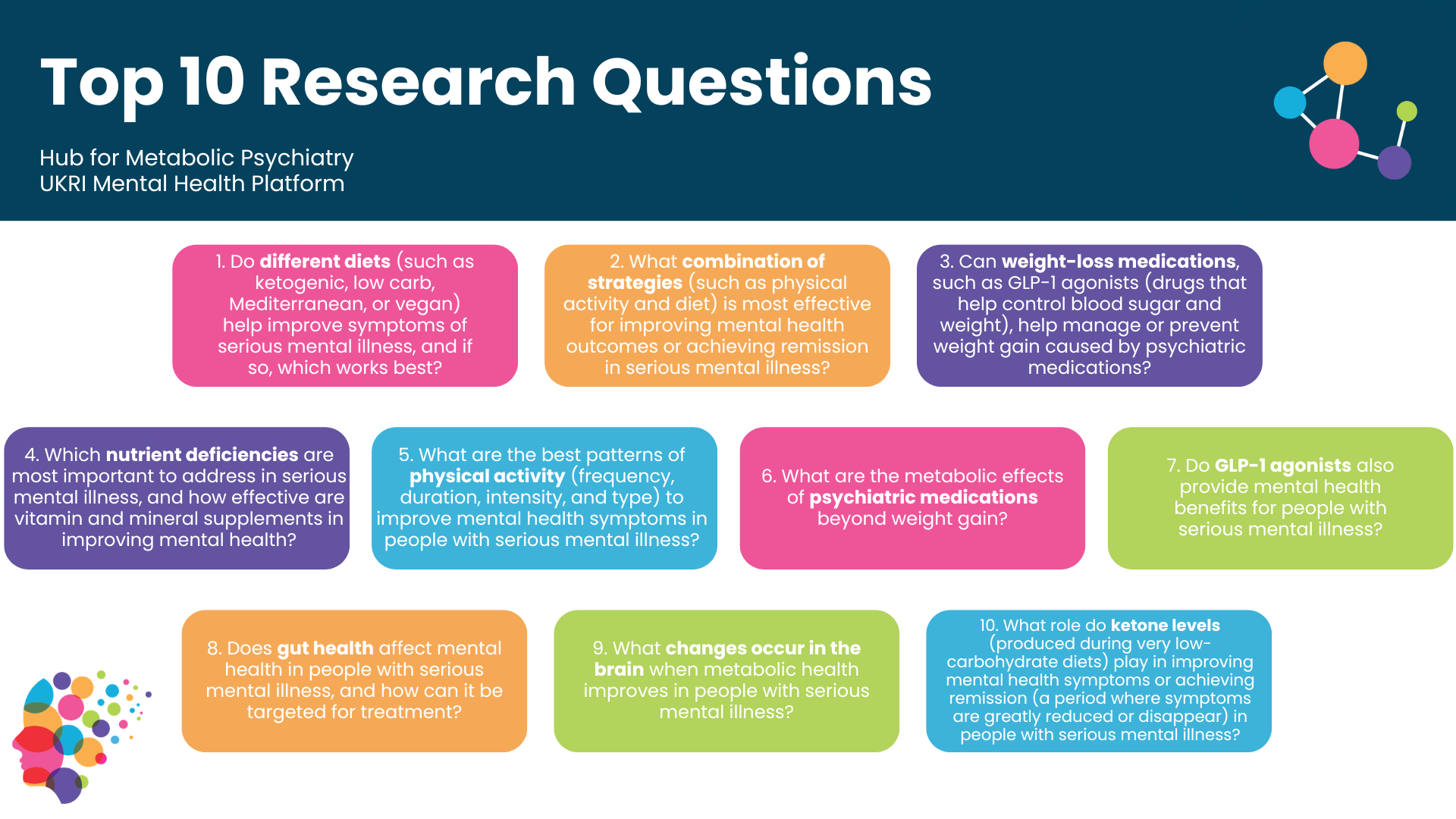
- Do different diets (such as ketogenic, low carb, Mediterranean, or vegan) help improve symptoms of serious mental illness, and if so, which works best?
- What combination of strategies (such as physical activity and diet) is most effective for improving mental health outcomes or achieving remission in serious mental illness?
- Can weight-loss medications, such as GLP-1 agonists (drugs that help control blood sugar and weight), help manage or prevent weight gain caused by psychiatric medications?
- Which nutrient deficiencies are most important to address in serious mental illness, and how effective are vitamin and mineral supplements in improving mental health?
- What are the best patterns of physical activity (frequency, duration, intensity, and type) to improve mental health symptoms in people with serious mental illness?
- What are the metabolic effects of psychiatric medications beyond weight gain?
- Do GLP-1 agonists also provide mental health benefits for people with serious mental illness?
- Does gut health affect mental health in people with serious mental illness, and how can it be targeted for treatment?
- What changes occur in the brain when metabolic health improves in people with serious mental illness?
- What role do ketone levels (produced during very low-carbohydrate diets) play in improving mental health symptoms or achieving remission (a period where symptoms are greatly reduced or disappear) in people with serious mental illness?

The Top 10 priorities highlighted a strong interest in understanding how metabolic interventions can improve mental health, not just physical health.
The highest-ranked priorities focused on dietary and lifestyle interventions, including questions about whether different dietary approaches can improve symptoms of severe mental illness and which approaches are most effective. Stakeholders also prioritised understanding the best combinations of diet and physical activity to improve symptoms and support recovery.
A particularly striking finding was that eight of the Top 10 priorities focused primarily on mental health outcomes, demonstrating that stakeholders are interested not only in improving physical health but also in understanding whether metabolic interventions can meaningfully improve psychiatric symptoms and quality of life.
How were they decided?
The PSP followed the established methodology of the James Lind Alliance (JLA), which brings together patients, carers, and professionals as equal partners in setting research priorities.
- The process began with the formation of a steering group that included people with lived experience of severe mental illness, carers, and clinicians. People with lived experience were involved throughout the project and played a key role in shaping every stage of the process.
- An international survey was then launched, inviting people with lived experience, carers, and health and social care professionals to submit questions they felt future research should address. More than 450 participants contributed over 1,400 questions.
- These submissions were reviewed and grouped into broader themes, resulting in a set of summary questions that captured the key uncertainties raised by participants. Existing evidence was then reviewed to determine which questions remained unanswered by current research.
- A second survey asked participants to rank the unanswered questions according to importance. Finally, people with lived experience, carers, and professionals came together in a structured consensus workshop to discuss and agree on the final Top 10 research priorities.
Importantly, people with lived experience were not simply consulted; they were involved as equal partners throughout the entire process, from designing the surveys and refining questions to participating in decision-making and helping determine the final priorities.
How did you resolve any differences?
There was a remarkable degree of agreement across stakeholder groups. People with lived experience, carers, and health and social care professionals shared many of the same concerns and priorities, particularly around improving mental health outcomes and addressing the physical health burden associated with severe mental illness. This strong alignment was evident throughout both the interim prioritisation survey and the final consensus workshop, where stakeholders consistently identified similar research priorities.
It is also important to note that the James Lind Alliance process is specifically designed to accommodate different perspectives. Rather than relying on voting alone, participants discussed priorities together in facilitated small-group discussions.
Through open dialogue, participants explored the reasons behind their rankings and worked towards a shared understanding. The final Top 10 priorities therefore represent a consensus across all stakeholder groups rather than the views of any single group.

How do these priorities compare with what researchers might have focused on without a PSP?
The priorities identified through the PSP differ in important ways from traditional research agendas.
Historically, research on metabolic interventions in severe mental illness has focused heavily on physical health outcomes such as weight loss, blood glucose levels, cholesterol, and cardiovascular risk factors. While these outcomes remain important, stakeholders consistently prioritised questions about mental health benefits, symptom improvement, functioning, and quality of life.
For example, the top-ranked priority was not about reducing weight or improving metabolic markers, but about whether different dietary approaches can improve symptoms of severe mental illness. Similarly, stakeholders showed strong interest in understanding the biological mechanisms linking metabolism and mental health, as well as whether treatments developed for metabolic conditions might have benefits for psychiatric symptoms.
These findings suggest a mismatch between the outcomes traditionally prioritised in research and the outcomes that matter most to people living with severe mental illness and those involved in their care. The PSP helps address this gap by ensuring that future research is more closely aligned with stakeholder needs and priorities.
What happens next?
The completion of the PSP is not the end of the process- it is the beginning of a new research agenda.
The Top 10 priorities provide a clear framework for researchers, funders, policymakers, and healthcare organisations to guide future investment and research activity in metabolic psychiatry. The next step is to translate these broad priorities into specific research studies that can generate high-quality evidence.
The priorities will be shared with funding organisations, research institutions, clinicians, and advocacy groups to encourage the development of research programmes that address the questions identified by stakeholders. In the UK, there are established funding pathways that specifically support research arising from James Lind Alliance Priority Setting Partnerships.

Ultimately, the goal is to ensure that future research addresses the questions that matter most to people with severe mental illness, leading to more relevant evidence, better treatments, and improved mental and physical health outcomes. By placing lived experience at the heart of research prioritisation, this PSP has created a stakeholder-driven roadmap for the future of metabolic psychiatry.
Published 17 July 2026
Setting priorities for SMI research
The Metabolic Psychiatry Hub published a paper in July 2026 about their “Priority Setting Partnership” project, which identifies research questions in a collaborative way.

Published 16 July 2026
Meeting of minds: Industry in conversation
Following the Industry Alliance Health and Wellbeing Forum in May 2026, two lived experience experts and two representatives from industry and research met to discuss key topics raised.

Published 17 June 2026
Uniting industry and academia: Medicines Discovery Catapult
Medicines Discovery Catapult (MDC) is a Life Sciences service that reshapes drug discovery to deliver better treatments for patients, and support our Industry Alliance. Sara Imariso and Ekta Patel from MDC tell us more.